How to Get to Phnom Kulen from Siem Reap (2026)
About 56 km by road, 1.5 to 2 hours by car, and one one-way road that closes to uphill traffic before midday. Here is how to reach Phnom Kulen without wasting the day.
Transport options and the one-way road timing
Distance and drive time from the park's published figures; the one-way road cutoff reflects the timing the operators we work with report.
Planning takeaway: Compare the journey and true inclusions of shared, private and jeep transport.
How far is Phnom Kulen from Siem Reap?
Phnom Kulen lies about 50 km (31 miles) straight-line north of Siem Reap, roughly 56 km by road. The drive takes 1.5 to 2 hours, since the last stretch climbs a slow mountain road. There is no train or direct bus, so effectively everyone gets there by car, with a private driver or on an organised tour.
Choose the kind of mountain day first, then compare current inclusions and the time you have.
On a map the distance looks like an easy hour, which is why the two-hour reality surprises people. The climb up the plateau is where the clock slows down. Build the drive into your plan as a real part of the day rather than a quick hop, and the trip feels relaxed instead of rushed. Start planning the visit with Phnom Kulen Tours.
For the wider context of the mountain you are heading to, see the complete national park guide. This page focuses on the getting-there logistics that make or break the day.
What are your transport options?
Four options realistically get you up the mountain: an organised tour, a private taxi or car with driver, a remork or tuk-tuk, and a rented motorbike. A tour or private car suits almost everyone, because both handle the distance and the one-way road. Tuk-tuks are slow for the climb, and self-driving puts all the timing on you.
The tuk-tuk that serves you so well around Siem Reap is not built for a 56 km run and a mountain ascent, so most drivers will decline or want a premium. Rented motorbikes are cheapest and most flexible, but the long ride, the dust and the road cutoff make them a confident-rider choice rather than a default.
| Option | Rough time | Best for | Watch out for |
|---|---|---|---|
| Organised tour | 1.5 to 2 hrs each way | First-timers, zero logistics | Set group pace |
| Private taxi or car | 1.5 to 2 hrs each way | Families, own schedule | Agree the return in advance |
| Remork or tuk-tuk | 2.5 hrs plus | Short-hop lovers on a budget | Slow, tough on the climb |
| Rented motorbike | Around 2 hrs each way | Confident independent riders | Dust, distance, road timing |
For most visitors the calm choice is a guided small-group tour with picnic lunch or the full-day trekking adventure, both of which absorb the driving and the timing so you can just enjoy the mountain.
What is the drive from Siem Reap actually like?
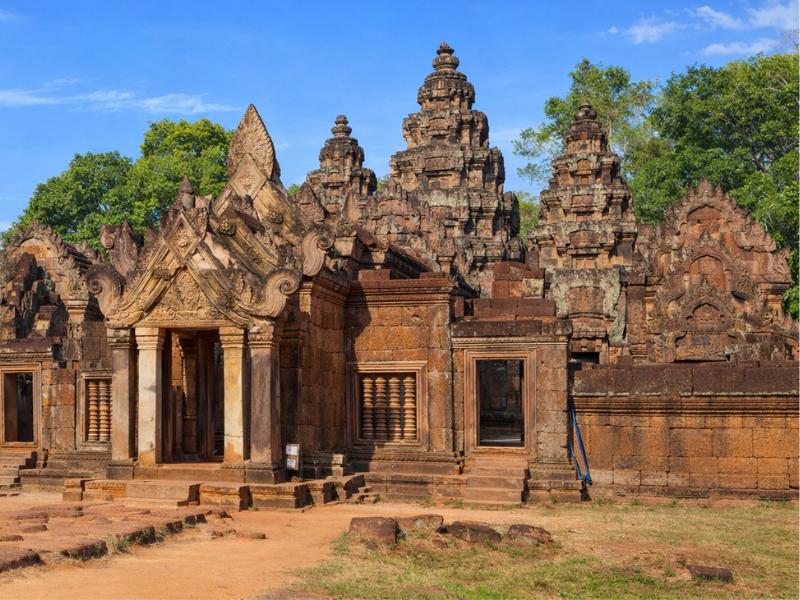
The route runs north out of Siem Reap on sealed road, past Banteay Srei, the pink-sandstone temple many people fold into the trip, then on to the base of the mountain. The first hour is flat and quick; the final stretch is the slow winding climb up the plateau, which is where most of the two hours actually goes.
It is an easy drive, not an ordeal, but the two halves feel different. Out of town you pass rice fields and villages at a good clip. Nearer the mountain the road narrows and rises, and the temperature drops a little as the jungle closes in. That change of scene is part of why the day feels like a proper excursion rather than a quick errand.
Because Banteay Srei sits right on the way, it is the natural add-on, and many combined tours pause there before or after the mountain. If temples are your thing, that pairing barely adds to the driving. The heavier jungle temple of Beng Mealea lies in the same direction and rounds out a longer day.
How much does a taxi to Phnom Kulen cost?
A private car or taxi for the day is the usual independent choice, and it is priced as a round-trip charter rather than a metered fare, since the driver waits for you on the mountain. Rates move with fuel, season and negotiation, so treat any figure as a starting point and confirm current prices before you commit.
The key thing to understand is that you are hiring the vehicle and driver for the whole day, including the wait time at the top, not just the kilometres. That is why a Phnom Kulen charter costs more than a short town hop, and why splitting it across a group of three or four brings the per-person cost down sharply.
Remember the $20 park entrance is separate and paid on top, in cash, at the gate. We break the numbers down in what a taxi to Phnom Kulen costs, and the fee itself in the park entrance fee explained.
One habit saves headaches: agree the full round trip, including how long the driver waits at the top, before you set off. A price quoted for a quick drop-off is not the same as a day charter with hours of waiting on the plateau. Settle that up front and there are no awkward conversations at the gate or on the way home.
How does the one-way road and timing work?
The mountain access road has historically run one-way with time windows: traffic goes up in the morning and comes down after midday, with the road up closing to vehicles around 11:30 AM. The park gate opens near 8 AM. Miss the late-morning cutoff and you cannot drive up, so an early start is not optional.
This single rule shapes every Phnom Kulen plan. It is the reason tours leave Siem Reap early and the reason a leisurely breakfast can quietly cancel your trip. The exact windows can change, so the safe move is to confirm the current timing locally, or let an operator carry that responsibility for you.
| Time of day | What the road allows | Your move |
|---|---|---|
| Around 8 AM | Gate opens, traffic heads up | Be on the road early |
| Before ~11:30 AM | Last window to drive up | Clear the cutoff with margin |
| Afternoon | Traffic descends | Enjoy the plateau, then come down |
On a guided trip you never think about any of this; the schedule is built around the cutoff. That is a big part of why first-timers lean toward tours for this particular mountain.
Guided tour or going independent?
A guided tour bundles the drive, the $20 entry, a guide and usually lunch, and it handles the one-way road so nothing goes wrong. Going independent by private car costs less if you share it and gives you full control of the schedule, but you carry the timing and the entrance fee yourself. First-timers usually prefer the tour.
The decision really turns on how much you value control versus simplicity. Families with young children and travellers on a tight day often love a private car for the freedom to linger or leave early. Solo travellers and couples who would rather not manage logistics tend to find a group tour the better trade.
| Approach | Roughly includes | Suits |
|---|---|---|
| Guided day tour | Transport, guide, entry, lunch, timing | First-timers, no-stress days |
| Private car, independent | Transport only; you add entry and food | Groups, flexible schedules |
Cost usually decides it for groups. Split across three or four people, a private car can undercut per-person tour prices, and you keep control of the schedule. For one or two travellers the maths flips, and a join-in tour often works out cheaper as well as simpler once the fee, fuel and a guide are counted.
Either way, remember the fee is separate on the independent route. If you would rather someone else own the whole day, browse the guided options in a full day-trip itinerary.
What does a realistic day-trip schedule look like?
A typical Phnom Kulen day trip leaves Siem Reap between 7 and 8 AM, reaches the plateau before the road cutoff, works through the pagoda, the carvings and the waterfall with a picnic lunch in the middle, and rolls back into town by mid to late afternoon. Count on a full day, not a half-day outing.
The early departure is the non-negotiable piece; everything else flexes around it. Front-loading the pagoda and lingas leaves the waterfall swim as a cooling reward and keeps you clear of the busiest midday crush at the pool.
| Time | Where | What happens |
|---|---|---|
| 7 to 8 AM | Siem Reap | Hotel pickup, drive north |
| 9 to 11 AM | Pagoda and carvings | Reclining Buddha, sacred riverbed |
| Midday | Plateau | Picnic lunch |
| 1 to 3 PM | Waterfall | Swim, photos, then descend |
| 4 to 5 PM | Siem Reap | Back in town |
Wondering how much time to set aside overall? See how long you need at the mountain before you lock your dates.
What time should you leave Siem Reap?
Work backward from the road cutoff. With a 1.5 to 2 hour drive and the road up closing to vehicles around 11:30 AM, a departure by 8 AM leaves comfortable margin, and 9 AM is about the latest that feels safe. Leave it later and you gamble the whole trip on traffic and the climb. Early is the only reliable answer.
The margin matters because the last stretch is a slow mountain road, and a single hold-up can eat your buffer. Guided trips build this in automatically, which is a large part of their appeal for this particular mountain. If you are going independently, treat the departure time as fixed and everything else as flexible.
| Leave Siem Reap | Reach the climb by | Verdict |
|---|---|---|
| 7:00 to 7:30 AM | Well before the cutoff | Ideal, cool, quiet at the falls |
| 8:00 AM | Comfortable margin | Safe and relaxed |
| 9:00 AM | Cutting it close | Latest sensible start |
| After 9:30 AM | Risk missing the road up | Not recommended |
Season shapes the day too, so glance at the best months to visit before you fix a date, since a rainy-season road runs slower than a dry one.
What mistakes do people make getting there?
The classic errors are all avoidable: a lazy start that misses the one-way road up, trying to make the climb by tuk-tuk, arriving in the late dry season expecting a full waterfall, and turning up with no cash for the $20 gate fee. Each one turns a good day into a frustrating one, and each is easy to plan around.
Missing the cutoff is the big one, and it comes straight from underestimating the drive. The tuk-tuk mistake follows close behind, since the vehicle that serves you so well in town struggles with 56 km and a mountain. Both are simple to avoid once you know the road runs one-way and the ascent is slow.
| Mistake | Why it hurts | The fix |
|---|---|---|
| Starting late | Miss the road-up cutoff | Leave Siem Reap by 8 AM |
| Taking a tuk-tuk | Too slow for the climb | Book a car or a tour |
| Wrong season for water | Thin dry-season falls | Go green season for the swim |
| No cash at the gate | The $20 fee is cash only | Carry small notes |
Pack for the heat and the swim as well; what to wear and bring covers the kit, and if you would rather hike in than drive the whole way, the trekking and hiking guide lays out the routes.
Can you combine Phnom Kulen with other sites?
Yes, and many tours do. The mountain pairs naturally with Banteay Srei, the pink-sandstone temple on the way north, and with the jungle temple of Beng Mealea. Some full-day trips even add a Tonle Sap village. Angkor Wat itself, though, is heavy enough to deserve its own separate day rather than a rushed add-on.
Combining sites works when they lie along the same northern route, which is why Banteay Srei and Beng Mealea slot in so cleanly. Trying to bolt Phnom Kulen onto an Angkor Wat day usually means doing both badly, since each is a full experience in its own right.
For combined itineraries, a Banteay Srei and Beng Mealea day or a Beng Mealea and Tonle Sap trip covers a lot of ground. On the Angkor question specifically, see visiting Phnom Kulen and Angkor Wat on the same trip.