How Long Do You Need at Phnom Kulen?
The honest answer is a whole day. The mountain is a long way up a one-way road, and its best parts, the falls, the carved riverbed and the reclining Buddha, are spread across the plateau.
Where the hours go on a Phnom Kulen day
Times are typical allowances, not a fixed schedule; the drive and the one-way road set the pace.
Planning takeaway: Allocate realistic hotel-to-hotel time and avoid promising a half-day tour.
How long do you need at Phnom Kulen?
Plan on a full day out of Siem Reap. The drive is 1.5 to 2 hours each way, and the mountain itself deserves 3 to 4 hours to cover the waterfall, the River of a Thousand Lingas and the reclining Buddha without rushing. Add lunch and you are looking at an 8 to 10 hour day, door to door.
Choose the kind of mountain day first, then compare current inclusions and the time you have.
The distance is what forces the math. Phnom Kulen sits about 50 km north of Siem Reap, and by road that is closer to 56 km on a route that climbs and slows near the top, so 1.5 to 2 hours each way is normal. Once you are up, the highlights are spread across the plateau rather than stacked in one spot, so moving between the waterfall, the carved riverbed and the pagoda eats time on its own. Most people leave town around eight in the morning and are back by late afternoon. Trying to shave it into a quick morning run leaves you rushing the parts worth slowing down for. Our full day-by-day plan lives in the Phnom Kulen day-trip itinerary.
The final ascent is the slow part. The route runs north past Banteay Srei, the pink-sandstone temple many people fold into a separate day, then climbs a winding mountain road where speed drops away, which is why the clock lands nearer two hours than one even though the map looks modest. Because that drive eats a real slice of daylight, the mountain works best as a single dedicated outing rather than something squeezed between temples. See how the tours line up at Phnom Kulen Tours.
How much time does each highlight take?
Give the waterfall the biggest slice, then the carvings, the pagoda and the viewpoints. A relaxed visit runs about an hour to ninety minutes at the falls with a swim, thirty to forty-five minutes each at the River of a Thousand Lingas and the reclining Buddha, a few minutes at the cliff viewpoints, plus lunch. The table shows a typical breakdown.
Here is how a standard day tends to divide, from hotel door back to hotel door.
| Segment | Typical time | Notes |
|---|---|---|
| Drive Siem Reap to the park | 1.5 to 2 hours | Climbs and slows near the top |
| Reclining Buddha at the pagoda | 30 to 45 minutes | Staircase climb, active shrine |
| River of a Thousand Lingas | 30 to 45 minutes | Carvings in the streambed |
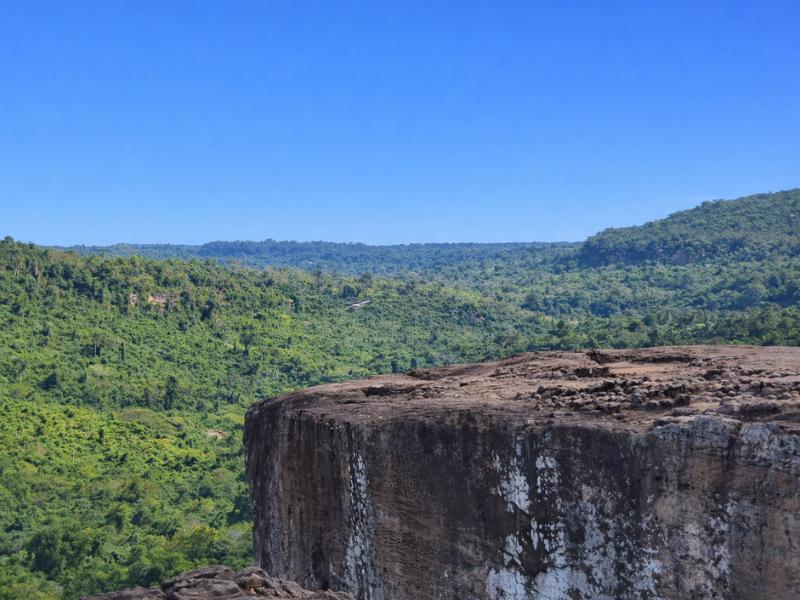
| Cliff viewpoints | 10 to 20 minutes | Long views over the forest |
| Waterfall and swim | 1 to 1.5 hours | The busiest, biggest slice |
| Picnic or local lunch | 45 minutes to 1 hour | Usually on the plateau |
| Drive back to Siem Reap | 1.5 to 2 hours | Watch the road-down timing |
| Full day, door to door | 8 to 10 hours | Depends on pace and traffic |
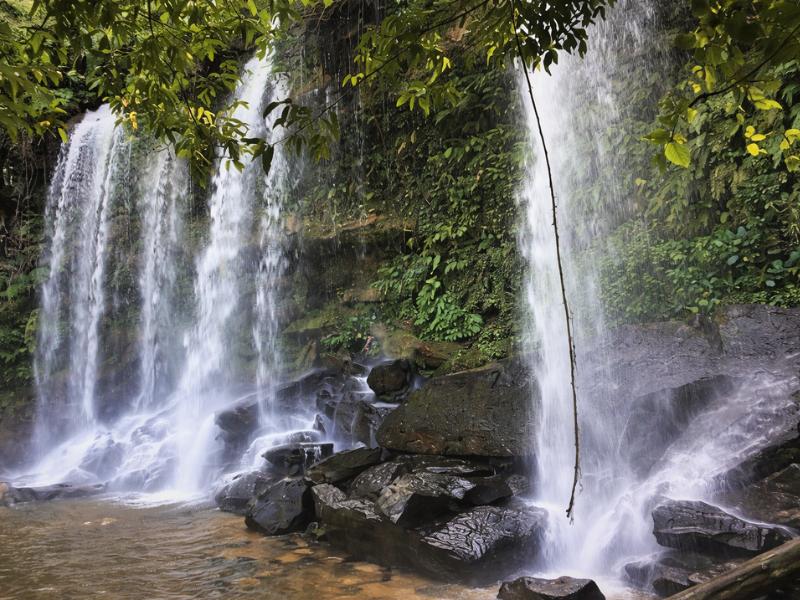
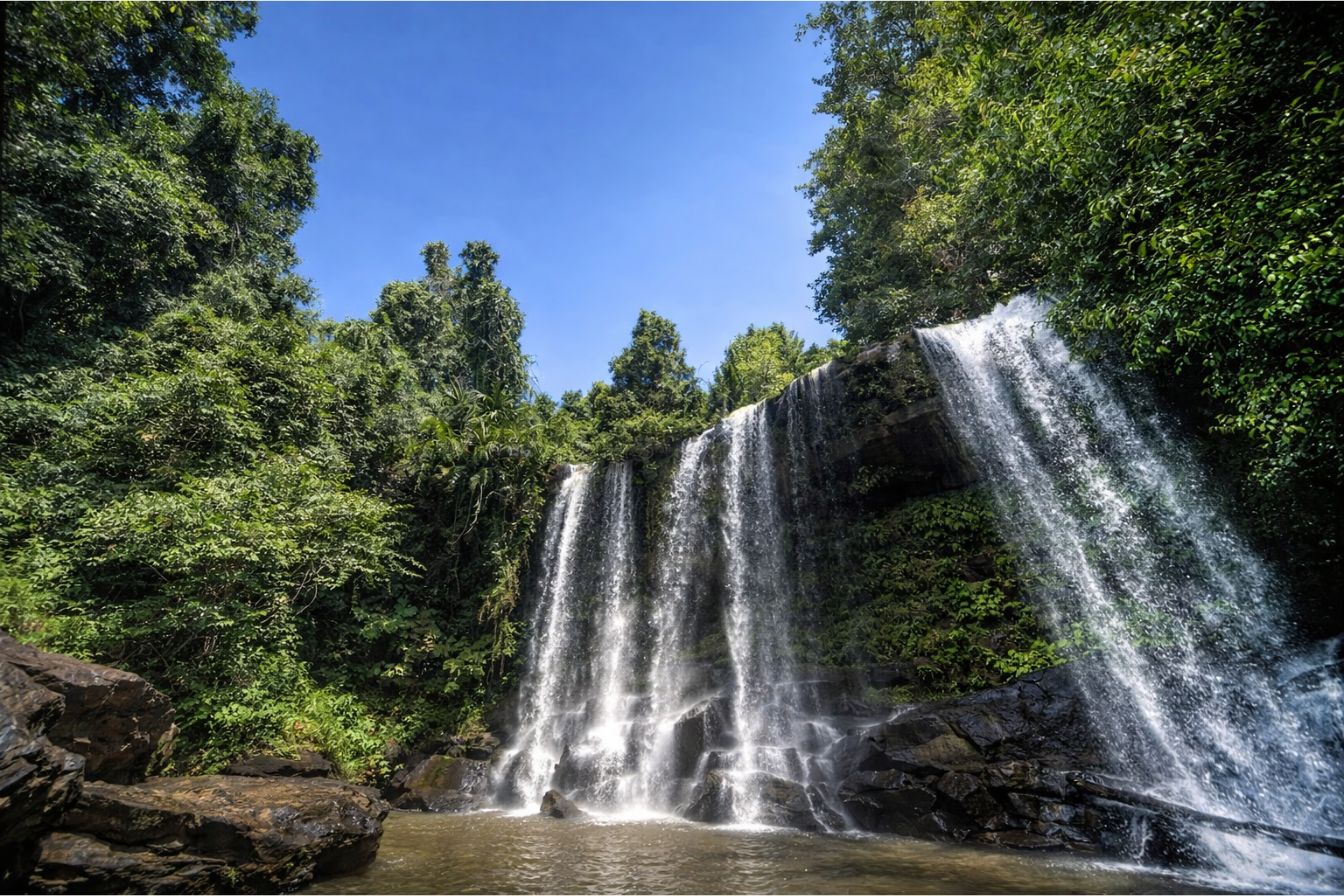
The waterfall earns the most time because it is where you swim, change, dry off and take the photos, and because it is the busiest stop so you may wait for space at the pool. The carvings and the Buddha reward a slower look but do not demand as long. Read exactly what you are seeing at the falls in the two-tier waterfall guide before you go, and you will spend your minutes better.
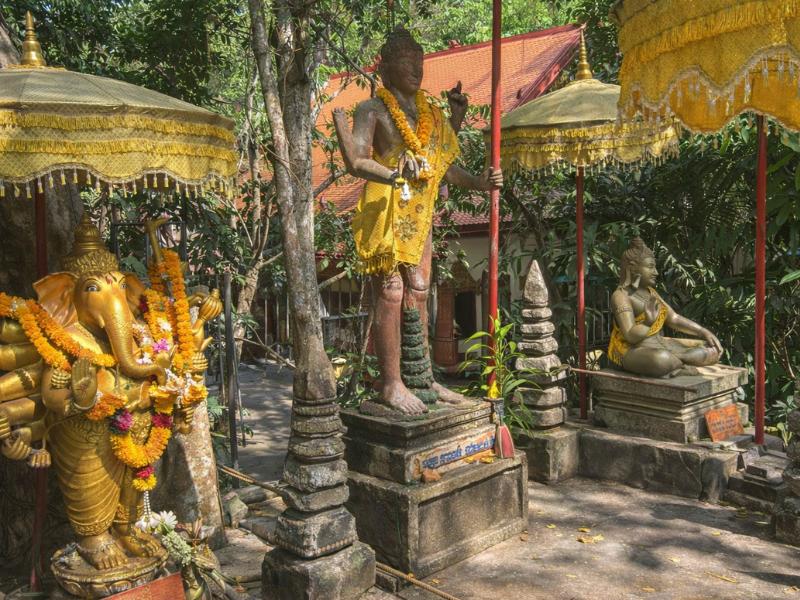
What fills those minutes is worth picturing. At the pagoda you climb a staircase past incense and prayer stalls to the reclining Buddha, then double back down. At the riverbed you walk a short forest path and look down into the carved streambed rather than up at a monument, so it rewards a slow, deliberate few minutes rather than a quick glance. The viewpoints are a brief stop, a long look over the forest and a photo. The falls are where the day pools, because swimming, changing and drying off simply take longer than looking does.
Can you do Phnom Kulen as a half-day trip?
Not comfortably. Between the 1.5 to 2 hour drive each way and a mountain access road that has historically run one way by time of day, a half-day leaves almost no time on top. Treat Phnom Kulen as a full-day commitment; if your schedule is tight, a closer sight makes a better half-day.
The one-way road is the quiet dealbreaker. When it is running uphill in the morning, you cannot simply turn around and race back for an afternoon plan, so the mountain sets the pace of the day, not you. That is part of why some travellers weigh up whether the mountain is worth the day trip before committing. For most, the falls, the carvings and the quiet forest earn the hours; for a packed itinerary, it may not fit.
What does a full day look like, hour by hour?
Most tours leave Siem Reap around eight, climb before the road up closes, and work down the plateau from the pagoda to the carvings to the falls, saving the swim for last. Lunch lands in the middle. Sequencing this way keeps the busiest, hottest stop off your freshest hours and turns the swim into a reward.
Here is one clean version of the day, from pickup to the drive home.
| Time | Where | What you do |
|---|---|---|
| 7:30 to 8:00 AM | Siem Reap | Hotel pickup, drive north |
| 9:30 to 10:15 AM | Preah Ang Thom | Climb to the reclining Buddha |
| 10:15 to 11:00 AM | Sacred riverbed | See the carved lingas |
| Midday | Plateau | Picnic or local lunch |
| 1:00 to 2:30 PM | Waterfall | Swim, photos, viewpoints |
| 2:30 to 4:30 PM | Road home | Descend and drive back |
Times shift with traffic, group size and how long you linger at the pool, so treat this as a shape rather than a timetable. The one fixed point is the early start. For the full sequence with tour options attached, see the day-trip itinerary.
Notice how the swim sits late in the plan on purpose. Reaching the pagoda and the carvings first means the busiest stop, the falls, is not where you burn your freshest hours, and it keeps a cool swim as the reward at the warmest part of the day. It also spreads you out from the tour buses, which tend to converge on the pool around the middle of the day and thin out again by mid-afternoon.
How does the one-way access road shape your timing?
It sets the clock, not you. The mountain road has historically run uphill in the morning and downhill after midday, with the climb closing to traffic around 11:30 AM. Miss the morning window and your plan unravels, which is why an early start matters and why a guided day, where the operator owns the timing, is the low-stress choice.
Because you cannot simply reverse and drive down in the late morning, the road turns a loose plan into a firm one. It is the main reason independent travellers on rented motorbikes sometimes have a rough day, and the main reason a booked trip removes the worry. The exact windows can change, so confirm them locally or let your operator carry that responsibility. Our full rundown of routes, drivers and pickup times sits in how to get to the mountain from Siem Reap, and a small-group tour with picnic lunch keeps the whole timing off your shoulders.
Half-day, full-day or combined: how do the options compare?
Three shapes cover most visits. A dedicated full day gives the mountain its due at a steady pace. A combined day trades some waterfall time to add Banteay Srei and Beng Mealea, running closer to ten hours. A two-day trek reaches the remoter carvings and quiet trails a single day cannot. The table lays out the trade-offs.
| Option | Hours | What you get | Best for |
|---|---|---|---|
| Full day, Kulen only | 8 to 10 hr | Falls, carvings, Buddha, unhurried | First visits |
| Combined day | About 10 hr | Kulen plus Banteay Srei and Beng Mealea | Seeing more in one go |
| Two-day trek | 2 days | Remote carvings, Srah Damrei, quiet trails | Trekkers and photographers |
Travellers who want more ground in the same day often take the Banteay Srei and Beng Mealea full-day tour, which trades a little waterfall time for two extra temples but runs long. If you would rather go deeper into the forest over two days, the trekking and hiking guide covers the routes and effort involved.
The combined day is the popular compromise, but be honest with yourself about stamina. Ten hours with several stops, a swim and a lot of driving is a full day by any measure, and the extra temples come out of the time you would otherwise spend at the pool. If the waterfall is the reason you are going, the Kulen-only day protects it; if you are collecting the region's highlights efficiently, the combined loop earns its length.
Who needs more time, and who needs less?
One well-paced day suits most first visits. Trekkers, photographers and anyone chasing the remote Srah Damrei elephant carving want a second day. Travellers short on time can still make it work by keeping the day tight and skipping a long lunch, but nobody should try to shrink Phnom Kulen below a full outing.
The mountain rewards patience more than speed. If you want soft morning light on the carvings, an unhurried swim, or the rough tracks out to Srah Damrei, build in the extra hours or the extra day. If you are simply ticking the headline sights, the standard full day is plenty. Either way, the honest verdict on whether the drive pays off, crowds and litter included, is in our take on whether Phnom Kulen is worth it.
When should you start to fit it all in?
Start early. The park opens around 8 AM, tour pickups run from about 8:00 to 8:20, and the one-way road favours an early climb. A prompt start beats the midday heat, gives the swim its best light, and leaves margin for the drive back before the afternoon fades.
Timing is really about the road and the light. An early departure means you climb while the access road is open uphill, reach the falls before the buses cluster, and swim when the sun is high enough to warm the pool. If you are choosing dates as well as a start time, our guide to the best time to visit Phnom Kulen lines up weather and water flow so the whole day lands right.