Why Is Phnom Kulen the Birthplace of the Khmer Empire?
In 802 CE, on top of this mountain, a king named Jayavarman II had himself proclaimed universal monarch and cut Khmer lands loose from Java. Historians mark that ceremony as the start of the Khmer Empire.
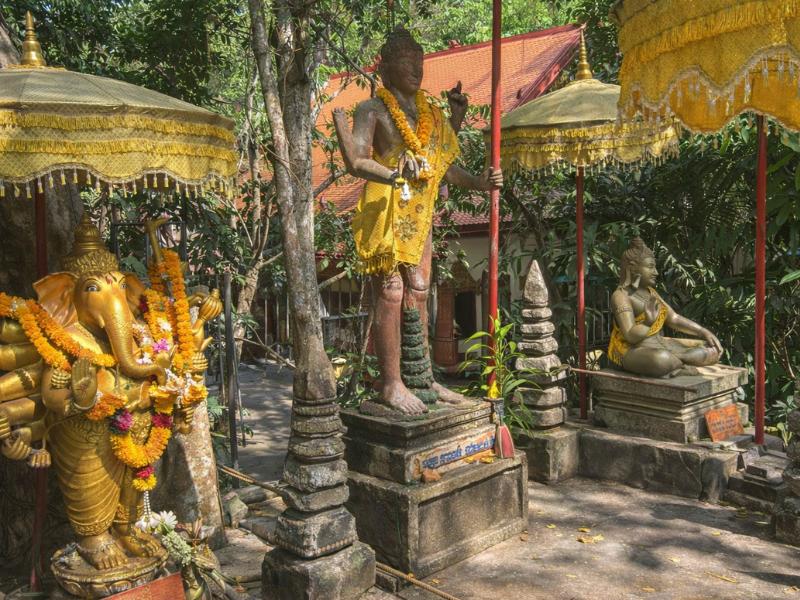
From a mountain ceremony to a lost city
A simplified timeline of the mountain's place in Khmer history, drawn from the standard record.
Planning takeaway: Connect Khmer origins to genuinely visitable sacred sites and Rong Chen.
Why is Phnom Kulen the birthplace of the Khmer Empire?
Because the founding act happened here. In 802 CE, Jayavarman II held a ceremony on Phnom Kulen declaring himself a universal monarch and independent from Java, drawing rival Khmer domains under one ruler. Historians treat that event, high on the sacred mountain, as the beginning of the empire that later built Angkor.
Choose the kind of mountain day first, then compare current inclusions and the time you have.
Before that moment there was no single Khmer state, only a patchwork of principalities, some paying tribute to powers overseas. Jayavarman II changed the map. By staging his consecration on the mountain and claiming supreme, unifying authority, he turned a scattered region into a kingdom with a centre and a founding date. Everything that followed, six centuries of temple-building on the plains below, traces its legitimacy back to this plateau. It is less a battlefield birthplace than a ceremonial one, which is exactly why the mountain still carries such weight in Cambodia today. Compare the options side by side with Phnom Kulen Tours before you go.
What happened in 802 CE on the mountain?
Jayavarman II was consecrated as a chakravartin, a universal or wheel-turning monarch, in a rite that also proclaimed the Khmer lands free of overlordship from Java. The ceremony is linked to the devaraja, or god-king, idea, which fused kingship with the divine and gave the new ruler a sacred authority above the old rival lords.
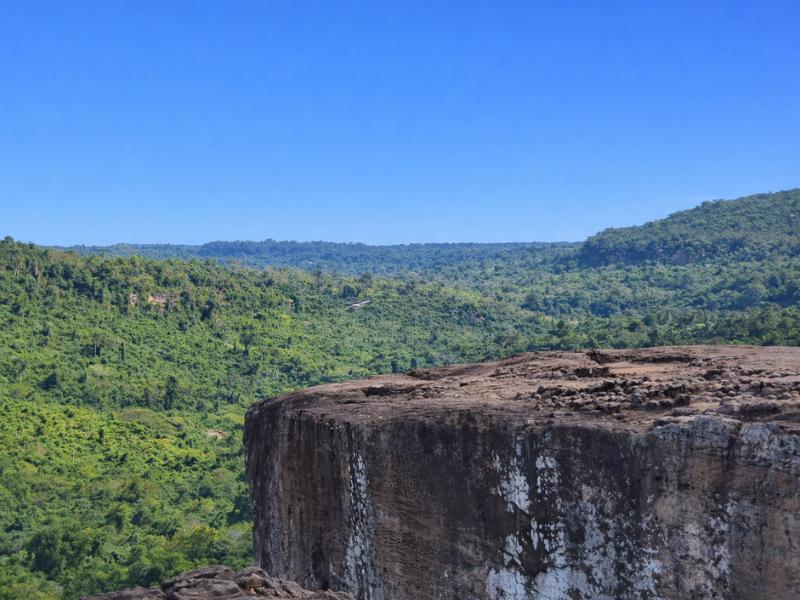
The detail that makes it a founding moment is the claim itself. Declaring one king supreme over all the others, and doing it with religious ceremony on a holy mountain, was a political act dressed as a sacred one. The devaraja concept let a mortal ruler stand as the earthly seat of divine power, which is why a mountaintop, closer to the heavens and already sacred, was the right stage. This is the single event modern histories point to when they date the empire, and it is why the story of the carved lingas upstream of the falls belongs to the same royal project of sanctifying the mountain.
What was Mahendraparvata, the lost city?
Mahendraparvata, meaning mountain of the great Indra, was an early Khmer capital that once spread across the Phnom Kulen plateau. For centuries it was swallowed by forest, until airborne lidar surveys in 2012 and 2013 mapped its buried street grid, revealing a planned city of roads, canals and building mounds hidden under the trees.
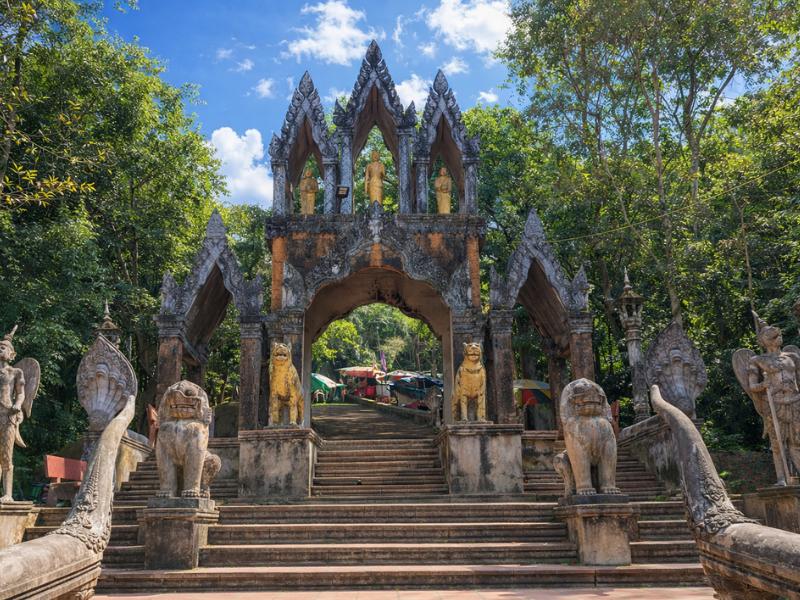
The lidar work rewrote what scholars thought they knew, exposing an orderly urban plan where there seemed to be only jungle. Here is the short arc of the mountain's history, from the founding rite to the modern rediscovery.
| When | What happened on the mountain |
|---|---|
| 802 CE | Jayavarman II is proclaimed universal monarch and declares independence from Java |
| Early 9th century | Mahendraparvata, an early capital, spreads across the plateau |
| Later 9th century | The court shifts down to Hariharalaya, in the Roluos area on the plains |
| 16th century | A giant reclining Buddha is carved into a sandstone boulder at Preah Ang Thom |
| 2012 to 2013 | Airborne lidar maps the buried streets of the lost city under the forest |
What the surveys did was strip the forest away in data. Aircraft flew over the plateau firing laser pulses at the ground, and the returns that slipped between the leaves built a bare-earth model of what lay beneath, tracing mounds, roads and canals in a deliberate grid. It was not one lost palace but the footprint of a whole planned city, evidence that people lived and farmed across this plateau long before Angkor rose on the plains. Much of it has never been dug up, both because the forest protects it and because the mountain's sacred status discourages disturbance.
Most of Mahendraparvata is still forest and archaeology rather than standing monuments, much of it unexcavated and protected by the mountain's continuing sacred status. The thrill is standing where a capital once was, not touring intact streets. For the fuller story, from the 802 CE consecration to what the surveys actually found, see our complete history of Phnom Kulen and the lost city.
Why did Jayavarman II choose this mountain?
Height, water and holiness. The plateau was defensible and set apart, it fed the rivers that watered the plains, and it was already sacred to both Hindus and Buddhists. For a king staging a divine kind of kingship, a holy mountain that literally sent life-giving water downhill was the ideal stage on which to be made a god-king.
That water link is not decoration. The same rulers carved the streambed on the mountain so the river would carry a blessing to the fields, and the practical and the sacred met in one gesture. The name Phnom Kulen means mountain of the lychees, a reminder that this was fertile, valued ground as well as spiritual high ground. Choosing a place that was defensible, holy and the source of the plains' water folded strategy, faith and farming into a single decision. Few sites in the region could have offered all three at once.
What happened after: how the capital moved to Angkor?
The mountain was the founding stage, not the lasting capital. Before long Jayavarman II shifted his court down to Hariharalaya, in the Roluos area on the plains, and later kings built their great capitals nearer present-day Angkor. Phnom Kulen kept its sacred status while power, water management and monumental temple-building moved to the flatlands below.
The move made practical sense. A vast agrarian kingdom needed the plains for its rice, its reservoirs and its huge temple complexes, which the mountaintop could not hold. So the story runs downhill: from the consecration on Phnom Kulen, to the early plains capital at Roluos, to the temple city around Angkor that most travellers picture when they think of the Khmer. The mountain remained the spiritual root of a state whose body had grown elsewhere. If you want to see the two chapters in one trip, weigh visiting the mountain alongside Angkor Wat.
Is Phnom Kulen part of Angkor or UNESCO?
No. Despite its founding role in Khmer history, Phnom Kulen is not part of the Angkor World Heritage listing. It is a national park with its own US$20 entrance fee, separate from the Angkor Pass. Its story underpins Angkor's, but the two are managed and ticketed apart, and several common beliefs about the mountain need correcting.
A few myths cling to the place, so here is what the record actually supports.
| Common belief | What is actually known |
|---|---|
| Phnom Kulen is part of Angkor or UNESCO | It is a separate national park with its own fee, not on the Angkor World Heritage list |
| You can walk an intact ancient city | The lost city is mostly forest and buried remains, mapped by lidar rather than restored |
| Angkor Wat was the first Khmer capital | The empire's founding act was on Phnom Kulen in 802 CE; Angkor rose generations later |
| Birthplace means a battle was won here | It marks a ceremonial consecration and a proclamation of unified kingship, not a fight |
Holding those straight makes the visit richer. You are not walking through the Khmer Empire's ruins; you are standing at the ceremonial spot where the idea of the empire began, on a mountain that stayed holy long after power moved on.
Why does the mountain still matter to Cambodians today?
Because it is a living holy place, not only a historical one. Phnom Kulen is sacred to both Hindus and Buddhists, a site of pilgrimage where Khmer families come to pray at the reclining Buddha, make offerings and picnic on weekends. The founding story gives it national weight, and its shrines keep it in daily religious use twelve centuries on.
That combination is what makes a visit feel different from touring a ruin. You are among people worshipping, not just sightseers, and the same plateau that anchors a national origin story also anchors an ordinary Sunday out for local families. The name, mountain of the lychees, points to another everyday layer: the fruit is grown and sold here, and the plateau has long been valued farmland as well as sacred ground. For visitors, that means dressing modestly near the shrines and giving the pagoda the respect Khmer pilgrims show it. It also means your US$20 supports a protected national park; our note on how the park ticket works explains where the fee goes, and the wider Phnom Kulen national park guide covers how the sacred and the scenic sit side by side.
What is left of that history to see today?
Plenty, though it is scattered. You can visit one of Cambodia's largest reclining Buddhas at the hilltop pagoda of Preah Ang Thom, the carved River of a Thousand Lingas, life-size stone animals at Srah Damrei deep in the park, and the plateau where the lost city lies under the forest. The waterfall and swim round out a day that is as much pilgrimage as sightseeing.
Because the sites are spread across the mountain and some are remote, a guided day makes the history legible rather than a series of unexplained stops.
| Site | What it is | Where on the mountain |
|---|---|---|
| Preah Ang Thom | A hilltop pagoda with a large reclining Buddha carved from one sandstone boulder | Near the plateau's main cluster of sights |
| River of a Thousand Lingas | The carved sandstone streambed that blesses the water | A short walk above the waterfall |
| The waterfall and pool | The two-tier fall with a swimmable lower pool | The busy heart of most day trips |
| Srah Damrei | Life-size stone elephants and animals | Remote, deep in the park for those who seek it out |
A private waterfall and historical wonders tour links the Buddha, the carvings and the falls with someone to explain the 802 CE story, and a Banteay Srei temple full-day tour with the park ticket sets Phnom Kulen beside the finely carved temple that came later. Seen together, they show how a ceremony on this plateau grew into an empire of stone.